IMPOWER Blog: Reorganisation, reform and the triple collision: what should directors of children's services worry about and when


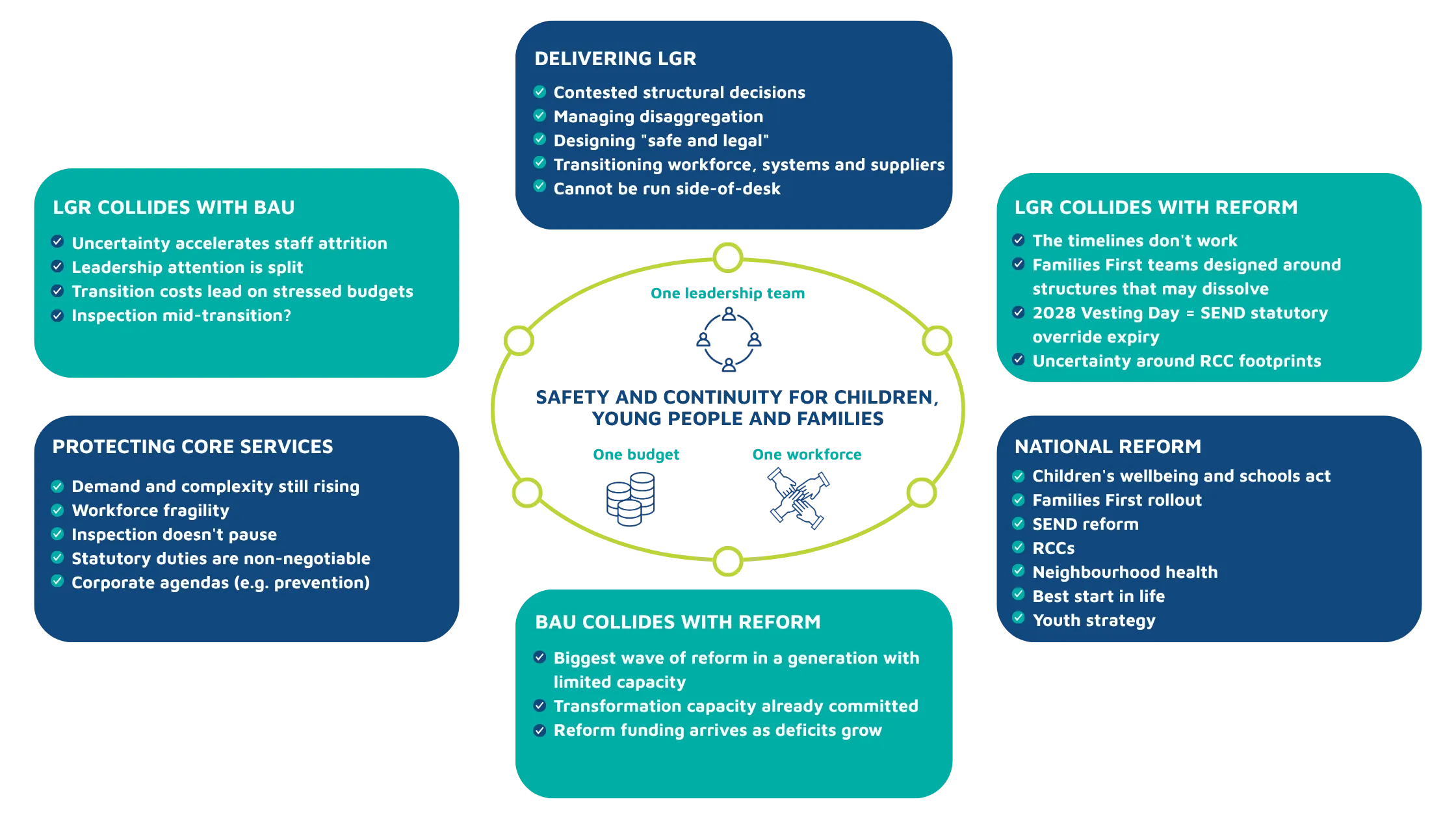
Recently, IMPOWER joined the County Councils Network for a discussion with directors of children's services (DCS) from authorities across England going through local government reorganisation (LGR). Between them, the directors represented services supporting millions of residents across the country. We started by recognising that each of them is being pulled in three directions at once: delivering LGR, navigating an unprecedented wave of national reform, and protecting core services under sustained demand and financial pressure.
Individually, each is a significant leadership challenge. Together, they have a compounding effect.
For example:
- Uncertainty is accelerating workforce attrition at a time when stability is more important than ever.
- Health, police and fire footprints are getting bigger whilst local government isn't necessarily moving in the same direction.
- Reform timetables were written for a stable system.
- Some services are at risk of being designed for regional footprints that may not survive structural decisions on LGR.
What the discussion kept returning to was the need to distinguish between what's urgent and what's important; and how easily the former crowds out the latter when you're operating at this pace. As one director put it: safe today is where we have to be, safe tomorrow is what we have to work towards, and the journey between those two points is the job.
One DCS with previous experience of LGR reflected that if they had their time again they would have banked more savings the year before the intensity of managing service transition ramped up; “with hindsight I had wriggle room I didn’t use”. As a result scarce headspace for managing transition was stretched even further by the need to continue delivering significant savings at the same time.
Another DCS framed the sequencing challenge simply: don't mess around with your staff twice. Design once, design well, and don't remodel for reform only to remodel again when the structural picture firms up.
These aren't arguments for doing less. Several DCSs were clear that reform can't simply be paused: the timetables don't move because you're busy. The authorities most likely to come through this period well are those who consciously sort their portfolio: the fundamentals that have to happen before vesting day, the things that collide and need more careful sequencing, and the changes that genuinely benefit from rolling forward into new authorities with fresh mandate and leadership. Those who'll struggle are those who let the loudest deadline decide.
That sorting is hard to do alone. It's harder still when those around you (corporate leadership, elected members, districts) are working from assumptions about what's achievable that don't yet reflect the operational reality of running children's services through transition.
The lesson from those who have been through large-scale reorganisation before is that success is rarely determined by how much change is attempted. It's determined by the discipline to sequence change well. For DCSs, that means protecting service stability while making careful choices about which reforms need to happen now and which are better delivered once the future organisational picture is clearer.
The greatest risk in the months ahead is not that too little happens, but that everything is treated as equally urgent. The authorities most likely to navigate the triple collision successfully will be those that make deliberate choices about what must happen before vesting day, what needs different sequencing, and what is best delivered through the new structures that follow.
Written by Martin Ellender, Director at IMPOWER

%20(1).webp)